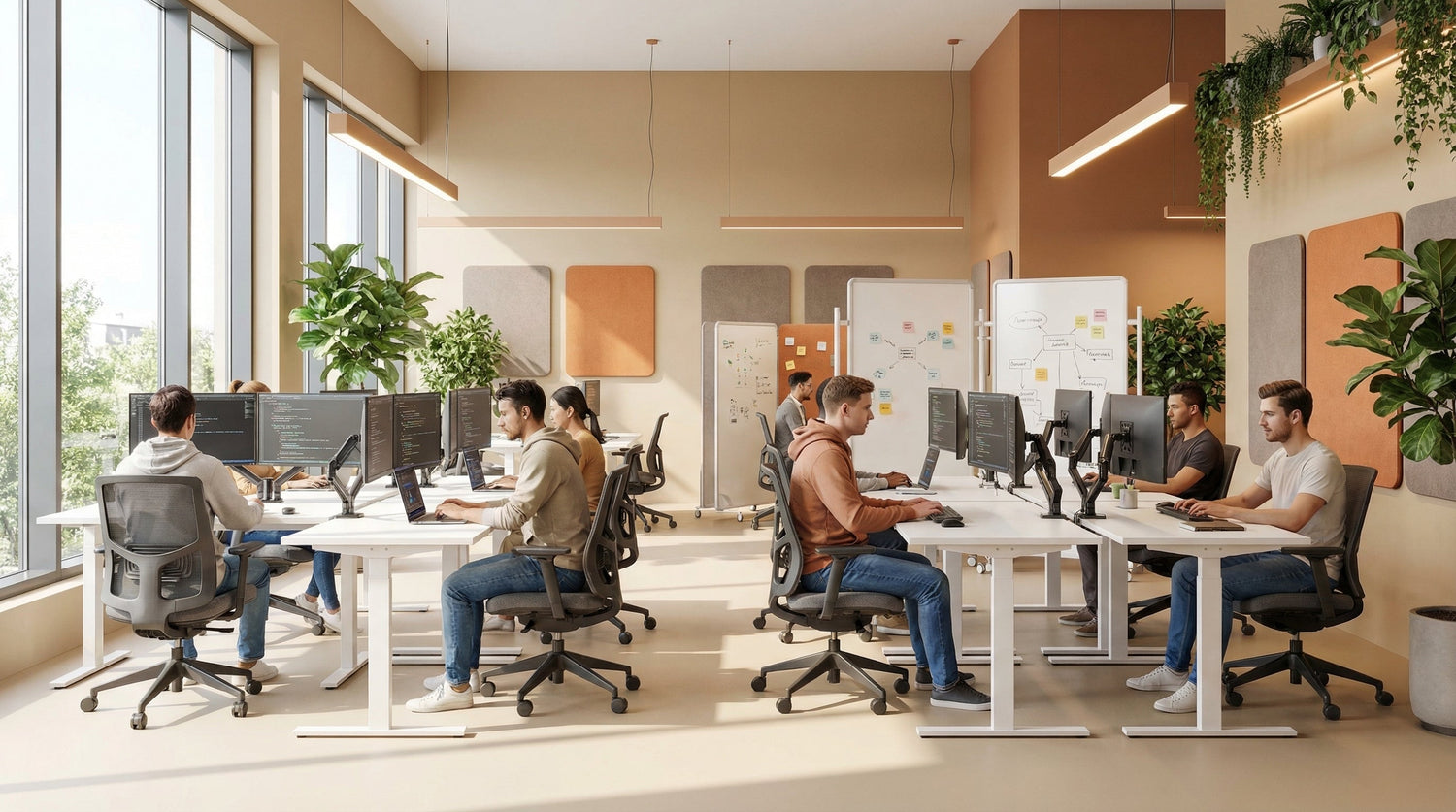
The U.S. office furniture market is projected to reach $27.7 billion by 2033, with adaptive workspace systems growing at 5.6% annually as seed-stage companies prioritize flexible, scalable solutions. Scaling engineering teams require reconfigurable desk systems that adapt to rapid headcount expansion, support hybrid work arrangements, and maintain professional aesthetics without requiring complete office redesigns every 6-12 months.
Koorbiir delivers scalable office furniture solutions engineered for startup environments, offering modular seating, height-adjustable desks, and reconfigurable workspace systems with free 5-day shipping across the United States. This guide identifies the most effective adaptive furniture strategies for fast-growing software firms experiencing rapid growth.
Why Scaling Engineering Teams Need Adaptive Workspace Solutions
Reconfigurable desk systems enable fast-growing companies to restructure workspace layouts within hours rather than weeks, reducing disruption during team expansions and supporting iterative workspace optimization. Traditional fixed furniture creates costly constraints when seed-stage companies scale from 10 to 50 employees within a single year.
Average office furniture budgets range from $1,500 to $3,000 per employee for ergonomic setups, making adaptive systems that grow with teams significantly more cost-effective than repeated furniture replacements.
In Koorbiir's experience serving over 50 Silicon Valley startups, we've observed that companies using fixed furniture arrangements wasted an average of $12,000 on abandoned furniture after Series B funding rounds, when rapid team expansion necessitated complete workspace redesigns. Fast-growing software firms face unique workspace challenges:
Startup-Specific Furniture Requirements:
- Rapid scaling: Headcount changes of 20-50% quarterly during growth phases
- Uncertain space needs: Difficulty predicting desk count requirements 6-12 months ahead
- Budget constraints: Limited capital for furniture investments during early funding stages
- Workspace agility: Need to pivot layouts for different team structures and work styles
- Talent attraction: Professional workspace aesthetics that compete with established companies
March 2026 data shows software sector employment growth continues accelerating, with SaaS companies adding employees at rates exceeding traditional industries. Seed-stage companies that invest in adaptive workspace layouts maintain flexibility through expansion phases without incurring replacement costs.
Essential Adaptive Furniture Categories for Fast-Growing Software Firms
Prioritize furniture investments in three core categories: reconfigurable workstations, scalable seating systems, and flexible collaboration furniture. These categories deliver maximum return on investment during rapid growth phases.

Reconfigurable Workstation Systems
Modular workstations enable quick reconfiguration without major renovations, with demand surging for demountable screens and mobile whiteboards. Scaling engineering teams benefit from workstation systems that adapt from individual focus areas to collaborative team zones through simple furniture rearrangement.

Key Adaptive Workstation Features:
| Feature | Startup Benefit | Scalability Factor | Budget Impact |
|---|---|---|---|
| Benching Systems | Maximizes density; easy to extend | Add seats without full reconfig | Lower per-seat cost |
| Height-Adjustable Desks | Supports sit-stand flexibility | Individual employee preferences | Mid-range investment |
| Mobile Pedestals | Moves with team restructuring | Zero reinstallation cost | Low maintenance |
| Cable Management | Professional appearance; safety | Accommodates tech changes | Prevents future costs |
| Demountable Panels | Privacy without permanent walls | Reconfigure team boundaries | Reusable across moves |
For rapid deployment scenarios, systems with tool-free assembly reduce installation time by 40% compared to traditional furniture. Koorbiir's height-adjustable workstations incorporate modular design principles with independent height adjustment, allowing mixed sitting and standing configurations that accommodate diverse work preferences without requiring matched furniture sets.

Benching vs. individual desks: Benching systems reduce footprint by 15-25% compared to individual desks with equivalent workspace, enabling higher employee density during rapid hiring phases. Individual desks provide greater personalization and acoustic separation for focused technical work.
Scalable Seating Solutions
Ergonomic seating with standardized adjustment features enables seamless employee transitions between workstations during team reorganizations. Fast-growing companies avoiding personalized seating assignments maintain flexibility to optimize team proximity and collaboration patterns.
Adaptive Seating Strategy:
- Standardized ergonomic chairs: Uniform adjustment features accommodate 95% of employee population
- Quick-release mechanisms: Enable rapid seat height and armrest adjustments for shared seating
- Mesh construction: Reduces maintenance compared to upholstered seating during high-turnover periods
- Stackable conference seating: Stores efficiently when meeting rooms convert to individual workspaces
-
Mobile lounge furniture: Reconfigures collaboration zones without installation labor

Standardized professional seating maintains aesthetic consistency during rapid team expansion while eliminating the need for personalized chair purchases that complicate workspace flexibility.
For scaling engineering teams, comprehensive adjustment systems (3D/6D armrests, lumbar support, seat depth) that accommodate diverse body types prove essential. Koorbiir's ergonomic seating collection offers these professional features at price points 40-50% below premium office furniture brands, preserving startup runway during critical growth periods.
Seat-to-employee ratios: Seed-stage companies typically provision 1.0-1.2 seats per employee to accommodate hybrid work schedules and flexible seating arrangements. Full-time remote organizations often reduce to 0.6-0.8 seats per employee when implementing hot-desking strategies.
Flexible Collaboration Furniture
Mobile collaboration furniture transforms spaces from focused work areas to team meeting zones within minutes, maximizing square footage utilization in startup environments. Fixed conference rooms consume 100+ square feet that remain unused 60-70% of typical workdays.
Collaboration Furniture Priorities:
- Wheeled whiteboard systems: Move between team areas without installation
- Nesting training tables: Expand from 6-person to 20-person configurations rapidly
- Modular lounge seating: Reconfigures from linear to circular arrangements
- Folding café tables: Transition breakrooms to all-hands meeting spaces
-
Mobile monitor stands: Support presentation requirements across multiple spaces
Foldable and wheeled furniture enables fast-growing software firms to maintain versatile spaces that serve multiple functions throughout each day, avoiding the square footage waste common in traditionally designed offices.
Workspace Layout Strategies for Rapid Team Expansion
Plan adaptive layouts that accommodate 30-50% team expansion without major furniture additions or space reconfigurations. Seed-stage companies often secure leases based on current team size, then face capacity constraints within 9-12 months during successful growth phases.
Phased Growth Planning
Phase workspace buildouts in 25% increments rather than furnishing entire leased space immediately. This approach preserves capital while maintaining expansion flexibility:
Phase 1 (0-25% space utilization):
- Core team workstations
- Primary collaboration zones
- Essential meeting space
- Reception area
Phase 2 (25-50% utilization):
- Expanded team seating
- Additional collaboration furniture
- Acoustic privacy solutions
- Storage systems
Phase 3 (50-75% utilization):
- Specialized work areas
- Enhanced meeting facilities
- Wellness spaces
- Visitor accommodations
Phase 4 (75-100% utilization):
- Density optimization
- Secondary collaboration zones
- Future expansion buffer
This phased approach reduces initial capital requirements by 40-60% compared to complete space buildouts, preserving startup runway during critical growth periods.
Density Optimization Techniques
2026 workplace trends emphasize modular systems with plug-and-play power and acoustic privacy solutions that maximize workspace density without sacrificing employee comfort or productivity.
Recommended Density Targets:
- Open benching: 60-80 square feet per employee
- Low-panel workstations: 80-100 square feet per employee
- Individual offices: 120-150 square feet per employee
- Collaboration zones: 15-20 square feet per employee (shared)
- Support spaces: 30-40 square feet per employee (kitchen, storage, circulation)
Scaling engineering teams typically achieve 150-200 square feet per employee in total when combining all space categories, significantly more efficient than traditional corporate offices at 250-300 square feet per employee.
Budget-Friendly Procurement for Seed-Stage Companies
Fast-growing software firms should allocate 60-70% of furniture budgets to core workstation and seating investments, reserving 20-25% for collaboration furniture and 10-15% for aesthetic enhancements. This allocation ensures functional workspace while maintaining capital efficiency.
Smart Investment Priorities
Priority 1: Ergonomic Seating ($200-400 per seat)
Quality seating delivers measurable productivity returns and reduces health-related absences. Professional ergonomics at startup-accessible price points, with adjustment features comparable to premium brands, support long-term employee comfort without excessive capital outlay.
Priority 2: Adjustable Workstations ($400-800 per station)
Height-adjustable desks support diverse work preferences and reduce musculoskeletal complaints common in all-day sitting environments. Benching systems reduce per-seat costs while maintaining adjustment capabilities.
Priority 3: Mobile Collaboration Furniture ($100-300 per piece)
Wheeled whiteboards, nesting tables, and mobile pedestals maximize space flexibility during growth phases. These investments deliver disproportionate value by eliminating fixed-function space constraints.
Priority 4: Acoustic Solutions ($50-150 per employee)
Desktop privacy screens, sound-absorbing panels, and acoustic phone booths address noise concerns in open startup environments without requiring architectural modifications.
Adaptive Furniture ROI Calculation
Reconfigurable desk systems deliver 3-5 year ROI through reduced reconfiguration costs and eliminated replacement requirements during growth phases. Compare these scenarios:
Traditional Fixed Furniture:
- Initial investment: $2,000 per employee × 20 employees = $40,000
- Year 2 expansion (15 employees): $30,000 + $8,000 reconfiguration = $38,000
- Year 3 layout change: $12,000 reconfiguration
- 3-year total: $90,000
Adaptive Furniture System:
- Initial investment: $2,400 per employee × 20 employees = $48,000
- Year 2 expansion (15 employees): $36,000 + $1,500 reconfiguration = $37,500
- Year 3 layout change: $2,000 reconfiguration
- 3-year total: $87,500
Despite higher initial per-seat costs, adaptive systems reduce total ownership costs through eliminated replacement expenses and minimized reconfiguration labor.
Technology Integration in Adaptive Workspace Layouts

Modern reconfigurable desk systems must accommodate power, data, and device connectivity requirements without permanent electrical installations. Scaling engineering teams require workspace infrastructure that supports laptop-centric work, multiple monitors, and collaborative screen sharing.
Essential Tech Integration Features
Power distribution systems: Adaptive workstations should include integrated power strips or surface-mounted outlets that eliminate extension cord tangles across open floor spaces. Plug-and-play power systems enable furniture reconfiguration without electrician involvement.
Cable management infrastructure: Concealed cable routing through desk frames, under-surface troughs, and vertical cable spines maintain professional aesthetics while preventing trip hazards during rapid workspace changes.
Monitor mounting compatibility: Desks with grommet holes or clamp edges accommodate monitor arms that free desk surface area and support ergonomic screen positioning across diverse employee heights.
Collaborative technology support: Mobile TV stands, wireless presentation systems, and portable conferencing equipment integrate with adaptive furniture to create flexible meeting zones without permanent audiovisual installations.
Gaming-style desks often incorporate comprehensive cable management and technology mounting features that translate directly to professional applications, supporting workspace requirements at budget-friendly price points.
Acoustic Considerations for Open Adaptive Layouts
Open workspace configurations require acoustic mitigation strategies to maintain productivity in high-density environments. Sound management becomes critical when teams exceed 15-20 employees in open floor plans.
Acoustic Solutions for Fast-Growing Companies
Modular acoustic panels: Desk-mounted screens with sound-absorbing materials reduce ambient noise transmission between workstations without requiring permanent installations. These panels reconfigure with furniture during layout changes.
Phone booth solutions: Enclosed phone booths provide acoustic privacy for video calls and focused work without consuming the square footage required for traditional private offices.
Soft surface integration: Mobile lounge furniture, acoustic ceiling tiles, and textile wall panels absorb sound reflections that create echo and noise amplification in hard-surface startup spaces.
Spatial zoning: Separate noisy collaboration zones from quiet focus areas through furniture arrangement rather than permanent walls, using modular bookcases and tall plants as visual and acoustic boundaries.
2026 trends emphasize acoustic privacy solutions including modular screens and privacy booths that address noise concerns in flexible workspace environments.
Sustainability and Circular Furniture Models
Scaling engineering teams increasingly prioritize sustainable furniture procurement that aligns with corporate values and appeals to environmentally conscious talent. Adaptive workspace layouts support sustainability through extended product lifecycles and reconfiguration capabilities that prevent premature disposal.
Sustainable Furniture Strategies for Seed-Stage Companies
Circular procurement models: Furniture-as-a-Service offerings enable startups to lease adaptive systems rather than purchase, eliminating disposal concerns during rapid growth transitions or office relocations.
Recyclable materials: Furniture manufactured from recycled content and designed for eventual recycling reduces environmental impact across product lifecycles.
Longevity through adaptation: Systems that reconfigure for changing needs avoid replacement cycles common with fixed furniture, extending useful life from 5-7 years to 10-15 years.
Local sourcing: Regional furniture procurement reduces transportation emissions while supporting faster delivery and simplified warranty service.
Koorbiir furniture incorporates sustainable materials and construction approaches that support startup environmental goals without premium pricing typically associated with eco-certified products.
FAQ
What is the recommended furniture budget for a 20-person tech startup?
Seed-stage companies should allocate $40,000-$60,000 for initial furniture when seating 20 employees. This budget covers ergonomic seating at $200-400 per seat, adjustable workstations at $400-800 per station, collaboration furniture, and essential storage. The allocation should prioritize core functionality over aesthetic upgrades during early funding stages.
Phased procurement strategies reduce initial capital outlay: purchase 60% of projected capacity immediately, reserving 40% of budget for expansion furniture as headcount grows. This approach prevents over-investment in furniture that may require reconfiguration within 6-12 months.
For rapid scaling phases, systems with tool-free assembly, such as Koorbiir's adaptive workstations, reduce deployment time by 40% and enable internal team installation without specialized labor costs.
How quickly can reconfigurable desk systems adapt during team growth?
Adaptive workspace layouts reconfigure within 2-4 hours for team expansions of 5-10 employees, compared to 2-3 days required for traditional fixed furniture. The speed advantage stems from wheeled components, tool-free assembly mechanisms, and standardized connections that enable rapid workspace changes.
Key time-saving features include pre-assembled benching sections that snap together without fasteners, mobile pedestals that eliminate drawer re-installation, and demountable privacy panels with clip-on attachments rather than permanent brackets. Desktop cable management systems with accessible routing channels allow quick cord reorganization without crawling under desks.
For companies experiencing 20%+ quarterly growth, rapid reconfiguration capabilities reduce productivity disruption and eliminate extended periods where newly hired employees work from temporary setups. Fast-growing software firms typically reconfigure workspace layouts 3-4 times annually during peak scaling periods.
Should startups invest in new or used modular furniture?
New adaptive furniture provides warranties, consistent aesthetics, and full configuration flexibility ideal for growing organizations. Manufacturers support customization requests, deliver complete component sets, and honor multi-year warranties that reduce maintenance costs. New furniture arrives with current safety certifications and ergonomic features reflecting latest workplace research.
Used furniture reduces initial costs by 40-60% but may limit configuration options due to discontinued product lines or incomplete component sets. Warranty support typically doesn't transfer to secondary buyers, creating maintenance risks. Aesthetic inconsistencies arise when mixing used furniture from different manufacturers or product generations.
Seed-stage companies expecting rapid growth typically benefit from new adaptive systems that scale seamlessly through multiple expansion phases. Organizations with stable headcount forecasts or temporary space needs may find used furniture cost-effective for initial buildouts, planning new furniture purchases for permanent locations.
How do adaptive workspace layouts support hybrid work arrangements?
Reconfigurable desk systems enable hot-desking strategies where employees reserve workstations rather than claiming permanent desks. This flexibility reduces required seat counts by 20-40% when significant portions of teams work remotely multiple days weekly. Hybrid arrangements lower real estate costs while maintaining adequate workspace for in-office collaboration days.
Successful hot-desking requires standardized seating with comprehensive adjustments that accommodate diverse body types, eliminating personalized chair configurations. Mobile storage solutions (rolling pedestals, locker systems) replace fixed desk drawers, allowing employees to transport personal items to different workstations daily. Digital desk reservation systems integrate with adaptive furniture to track availability and utilization patterns.
Fast-growing software firms implementing hybrid models typically provision 0.8-1.0 desks per employee, compared to 1.0-1.2 desks in traditional full-time office environments. The reduced furniture requirements free capital for other growth investments while maintaining workspace quality on high-attendance days.
What features matter most for engineering team productivity in adaptive workspaces?
Engineering productivity depends on five core furniture features: height-adjustable desks supporting sit-stand flexibility, ergonomic seating with comprehensive adjustments, integrated power access eliminating extension cord clutter, cable management systems maintaining clean aesthetics, and mobile collaboration furniture enabling spontaneous team discussions.
Height adjustment proves critical for developers spending 8-10 hours daily at workstations. Even modest position changes throughout the day reduce back pain and fatigue. Desks with memory height presets enable instant transitions rather than manual adjustment processes that discourage regular use.
Ergonomic seating requires seat depth adjustment for proper thigh support, lumbar height customization for lower back alignment, and armrest positioning that prevents shoulder strain during extended keyboard use. Mesh backrests provide breathability during long coding sessions.
Power accessibility matters significantly in engineering environments with multiple monitors, laptops, external drives, and charging peripherals. Desktop power modules eliminate the productivity friction of crawling under desks to access outlets. Cable management prevents tangled cords that create visual distraction and trip hazards.
Mobile whiteboards and nesting tables support the collaborative problem-solving sessions essential to software development. Teams reconfigure spaces for pair programming, code reviews, and architecture discussions without permanent meeting room reservations that fragment schedules.
Conclusion

Scaling engineering teams require adaptive workspace solutions that accommodate rapid headcount expansion, support hybrid work arrangements, and maintain professional aesthetics without requiring frequent furniture replacements. Reconfigurable desk systems, scalable seating solutions, and flexible collaboration furniture deliver maximum return on investment through reduced reconfiguration costs and extended product lifecycles.
Koorbiir provides comprehensive adaptive furniture solutions engineered for fast-growing software firms, from ergonomic seating with standardized adjustments to height-adjustable workstations and mobile collaboration systems. The brand's commitment to scalable design and startup-accessible pricing enables seed-stage companies to create professional workspaces that grow seamlessly with their teams.
Ready to furnish your growing tech startup? Explore Koorbiir's modular office furniture collection featuring ergonomic seating, adjustable workstations, and flexible collaboration solutions with free 5-day shipping across the United States.


Leave a comment
This site is protected by hCaptcha and the hCaptcha Privacy Policy and Terms of Service apply.