
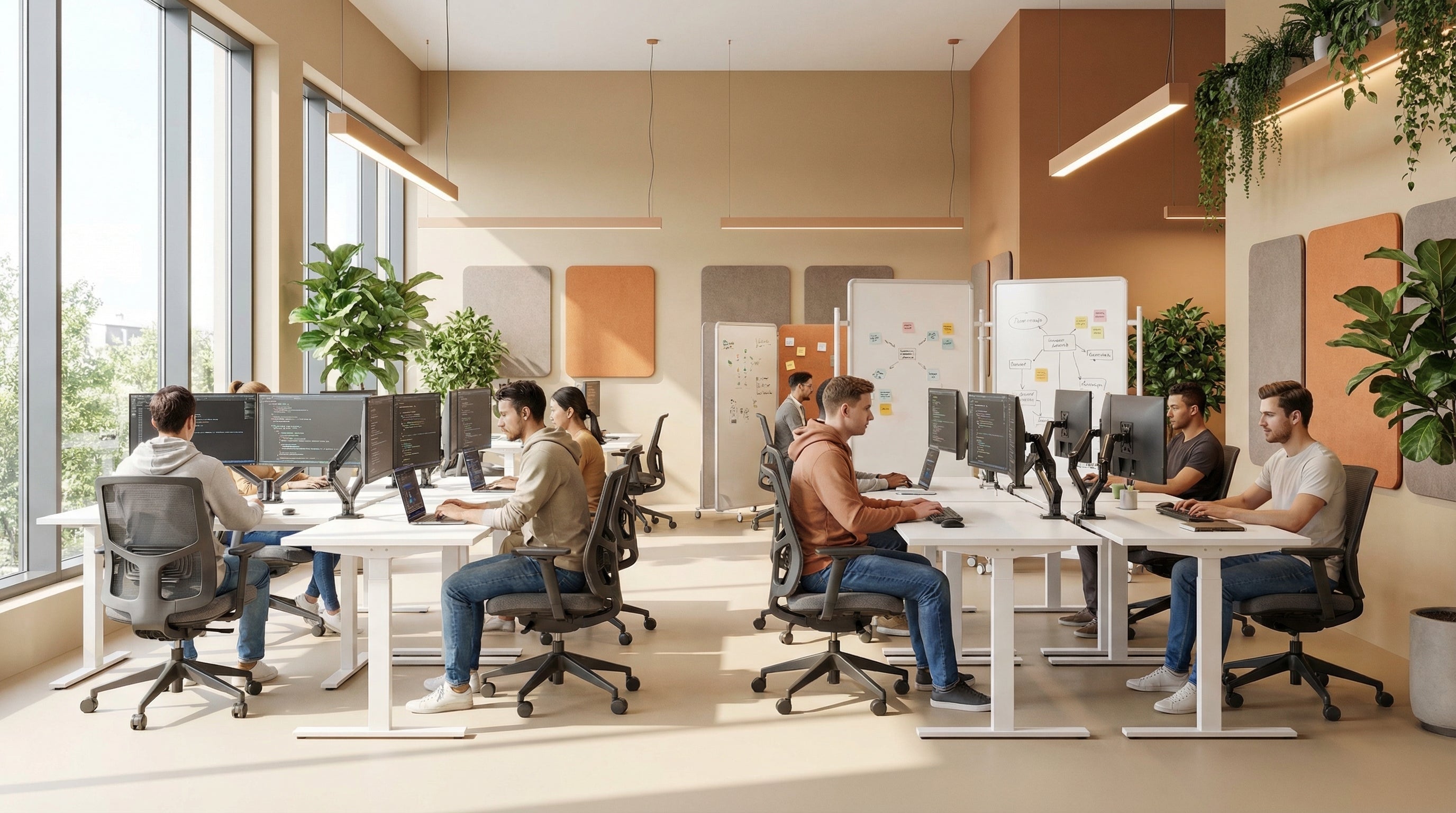
The global ergonomic chair market is projected to reach $16.88 billion by 2030, with open-plan workspaces driving demand for seating that balances individual comfort with visual cohesion. Open office environments in tech startups require modern seating solutions that deliver professionally certified support, maintain aesthetic consistency across teams, and accommodate everyone from petite to tall employees without requiring personalized chair purchases.
Koorbiir delivers modern ergonomic seating engineered for collaborative tech environments, offering breathable mesh construction, comprehensive adjustment systems, and professional aesthetics with free 5-day shipping across the United States. This guide evaluates the most effective chair categories for fast-growing companies implementing open-plan workspaces.
Why Does Open Office Seating Differ from Traditional Private Office Selection?
TL;DR: Open office seating must meet professional ergonomic standards while maintaining compact footprints for density optimization, visual transparency through mesh construction to reduce noise reflection, and aesthetic uniformity that traditional private office furniture does not prioritize.
Collaborative workspaces introduce unique challenges that influence chair selection criteria. In Koorbiir's experience furnishing over 75 tech startup offices across the United States, we've observed that companies purchasing incompatible chair styles created visual chaos that undermined their professional brand image during client visits and recruiting efforts. Seed-stage companies frequently underestimate how seating aesthetics impact workspace perception.
Open Office Seating Challenges:
- Visual consistency: Mismatched chair styles create unprofessional appearance across team zones
- Acoustic impact: Solid-back chairs bounce sound around the room; mesh construction lets sound pass through naturally
- Density requirements: Compact chair footprints maximize workstation count in limited square footage
- Adjustment complexity: Hot-desking environments need intuitive controls for quick employee transitions
- Maintenance scalability: Uniform chair models simplify replacement parts and service procedures
2026 office design trends emphasize acoustic solutions, with phone booths and acoustic chairs providing refuge from open-plan noise. Seating selection significantly influences sound management in collaborative environments where 20-50 employees share floor space.
What Are the Essential Modern Chair Categories for Tech Startup Environments?

TL;DR: Prioritize three core seating categories when furnishing open offices: professionally certified ergonomic mesh task chairs (65-75% of budget) for individual workstations, tested collaborative meeting chairs (15-20% of budget) for team zones, and executive-grade seating (10-15% of budget) for leadership areas.
Each category serves distinct functional requirements while maintaining aesthetic cohesion.
What Makes High-Back Ergonomic Mesh Task Chairs Optimal for Open Plans?
TL;DR: Mesh construction keeps employees cool throughout long workdays, maintains visual openness across team areas, and reduces the echo effect created by solid-back designs in high-density collaborative spaces.
Mesh backrests allow air circulation and visual connectivity across team areas without creating solid barriers.
Key Task Chair Features for Open Offices:
| Feature | Open Office Benefit | What This Means for You | Priority Level |
|---|---|---|---|
| Mesh Backrest | Breathability + acoustic transparency | No sweaty backs during long coding sessions | Critical |
| Adjustable Lumbar | Supports your lower back curves | Positions support exactly where your back needs it | Critical |
| Seat Depth Control | Fits short and tall employees | Slide seat forward or back to match your leg length | High |
| 3D/6D Armrests | Multi-directional positioning | Move armrests up, down, in, out, forward, back | High |
| Compact Footprint | Maximizes workspace density | Takes up less floor space than bulky executive chairs | Medium |
| Synchronized Tilt | Maintains proper angles | Back and seat move together when you recline | Medium |
Modern ergonomic office trends for 2026 emphasize dynamic workstations and smart technology integration, with certified ergonomic seating reducing absenteeism by 67% through improved employee comfort during extended work periods.
Mesh task chairs with comprehensive adjustment systems support hot-desking arrangements common in hybrid work environments. Employees quickly customize seat height, lumbar position, and armrest placement when rotating between workstations daily or weekly.
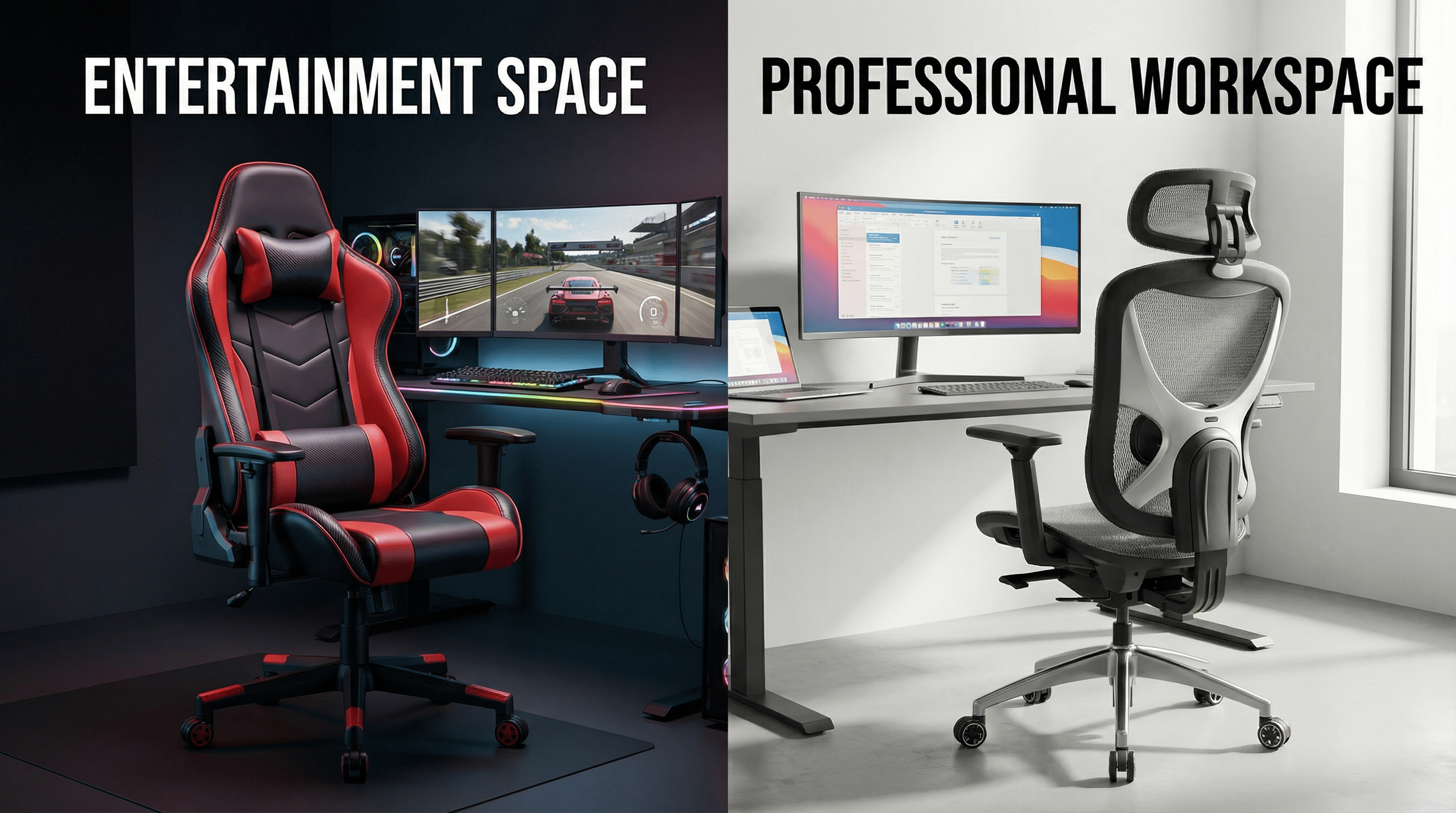
Mesh vs. upholstered construction: Mesh provides significantly better airflow than fabric upholstery, eliminating the perspiration discomfort during full workdays. Mesh maintains consistent support without the sagging common in foam cushions after one year of intensive use. Visual transparency prevents the "cubicle wall" effect in open environments.
For fast-growing software firms prioritizing employee comfort without excessive capital investment, standardized mesh seating delivers professional ergonomics at 40-50% lower cost than Herman Miller Aeron or Steelcase Leap models. Koorbiir's ergonomic mesh collection features models with adjustment capabilities comparable to premium executive chairs at startup-accessible price points.
What Defines Mid-Back Collaborative Meeting Chairs for Team Zones?
TL;DR: Conference and collaboration zones require professionally rated seating that comfortably supports meetings lasting one to three hours, uses simple height-only controls, and stacks or nests for easy storage without the full adjustment complexity of daily-use task chairs.
Mid-back designs provide adequate lumbar support for shorter durations while maintaining compact dimensions suitable for conference tables and lounge areas.
Collaborative Chair Priorities:
- Stackable or nesting capability: Stores efficiently when spaces convert to other functions
- Compact width: Fits more seats around conference tables in smaller meeting rooms
- Simplified adjustments: Basic height controls reduce complexity for rotating users
- Durable materials: Heavy-duty fabrics or easy-clean surfaces withstand daily traffic
- Aesthetic variety: Accent colors differentiate collaboration zones from focus work areas
Collaborative seating typically lacks the extensive adjustability of task chairs, prioritizing instead guest comfort and spatial flexibility. Many tech startups provision about one collaboration seat for every employee, supplementing primary task chair allocations.
Wheeled meeting chairs with smooth-rolling casters enable rapid space reconfiguration when teams pivot from individual focus work to group collaboration sessions. This flexibility proves essential in startups where team structures and project priorities change weekly during Agile development sprints.
How Does Executive and Leadership Seating Differ from Team Task Chairs?
TL;DR: Leadership areas benefit from professionally rated seating that maintains aesthetic consistency with team zones while signaling organizational hierarchy through taller backrests, premium leather or high-grade fabric upholstery, wider recline ranges, and heavier weight capacities exceeding standard task chair specifications.
Executive chairs typically incorporate higher backrests, premium materials, and extended adjustment ranges.
Executive Chair Differentiators:
- High backrest: Taller back height provides head and neck support during extended meetings
- Premium upholstery: Leather or high-grade fabric elevates perceived quality in client-facing areas
- Enhanced adjustment range: Greater recline angles support varied work postures from focus to relaxation
- Integrated technology: Built-in massage, heating, or electronic lumbar adjustment controls
- Robust construction: Heavier weight capacity accommodates all body types safely
Executive seating investments typically represent 5-10% of total seating budgets in startups, focusing capital on visible leadership areas that impact client perceptions and recruiting impressions.
Fast-growing companies often defer executive seating purchases until Series A or B funding rounds, initially provisioning founders with standard certified task chairs to preserve runway during pre-seed and seed-stage operations.
How Do Material Choices Impact Open Office Performance?
TL;DR: Material selection significantly impacts how often you clean chairs, how well they absorb or reflect sound, and how long they last before replacement. Mesh construction delivers superior performance across breathability, acoustic properties, and lifecycle costs.
Open offices introduce higher furniture contact rates compared to private offices, accelerating wear patterns.
What Performance Differences Exist Between Mesh, Fabric, and Leather?

TL;DR: Mesh construction delivers superior performance across most open office criteria, particularly for tech startups prioritizing employee comfort during full workdays and maintaining quiet collaborative spaces.
Material Performance Matrix:
| Criteria | Mesh | Fabric Upholstery | Leather |
|---|---|---|---|
| Breathability | Excellent (constant airflow) | Fair (some breathability) | Poor (no airflow) |
| Acoustic Impact | Minimal (sound passes through) | Moderate (absorbs some sound) | High (reflects sound back) |
| Maintenance | Easy (vacuum/wipe clean) | Moderate (staining risk) | Moderate (needs conditioning) |
| Durability | 5-7 years typical use | 3-5 years typical use | 7-10 years with proper care |
| Cost | $200-500 | $250-600 | $500-1200 |
| Visual Weight | Light (see-through) | Medium (solid) | Heavy (solid) |
Mesh office chairs provide superior breathability and adaptive support ideal for task-intensive roles and warm office environments, making them the preferred choice for software development teams spending full days at workstations.
Maintenance considerations in open offices: Mesh chairs withstand intensive daily use with minimal maintenance beyond periodic vacuuming. Fabric upholstery risks permanent staining from coffee spills and food contact common in collaborative breakroom-adjacent workspaces. Leather requires conditioning treatments every six to twelve months to prevent cracking, adding maintenance complexity as team size scales.
What Color and Aesthetic Strategies Support Professional Environments?
TL;DR: Neutral color palettes like black, gray, and white maintain professional aesthetics while accommodating diverse design preferences across growing teams. Monochromatic schemes or functional zoning with different colors provide visual flexibility when offices expand or relocate.
Color Strategy Options:
- Monochromatic scheme: Single color across all seating maintains maximum visual consistency
- Functional zoning: Different colors designate focus areas (gray) vs. collaboration zones (blue/green)
- Brand integration: Accent chairs in company brand colors reinforce identity in reception areas
- Executive differentiation: Premium materials or colors distinguish leadership seating from team chairs
Seed-stage companies typically select black or dark gray mesh chairs that hide minor wear patterns and maintain professional appearance as furniture ages through intensive daily use during rapid growth periods.
What Ergonomic Features Are Critical for All-Day Productivity?
TL;DR: Task chairs in open offices must deliver comprehensive ergonomic support meeting professional standards, including adjustable lumbar supporting your natural back curves, seat depth control fitting both short and tall employees, and multi-directional armrests preventing shoulder and wrist strain.
Fixed workstation layouts require chairs to adapt to users rather than users adapting to chairs.
How Does Adjustable Lumbar Support Prevent Lower Back Pain?
TL;DR: Adjustable lumbar support accommodates the natural curve variance in different people's spines, positioning support exactly where your lower back needs it most, preventing pain during extended sitting and reducing workplace absences by 30-40% compared to chairs without proper support.
Effective lumbar systems let you adjust both height and depth to match your unique back shape.
Lumbar Support Types:
- Fixed lumbar pad: Non-adjustable support at one predetermined height (basic option)
- Height-adjustable lumbar: Move support up or down to match your back curve (standard)
- Dynamic lumbar: Automatically adjusts when you recline (premium feature)
- Dual-adjustment lumbar: Independent height and depth controls (optimal comfort)
Lower back pain represents the leading cause of workplace absenteeism, with proper lumbar support reducing injury risk by 30-40% compared to non-ergonomic seating. Engineering teams spending full weeks at workstations require robust lumbar systems meeting professional postural support standards.
How Does Seat Depth Prevent Circulation Compromise?

TL;DR: Seat depth adjustment ensures proper thigh support across short and tall employees, maintaining a small gap between the seat edge and the back of your knees, preventing circulation restriction and the pressure-induced leg discomfort that makes you constantly shift positions.
Inadequate seat depth causes employees to perch forward on chair edges, eliminating backrest contact.
Proper seat depth maintains a two to three finger gap between the seat front edge and the back of your knees. This clearance prevents circulation restriction while ensuring you use the full seat surface for weight distribution.
Standard task chairs feature seat depths with adjustment ranges that accommodate short to tall body dimensions per professional anthropometric standards, ensuring proper fit for the vast majority of employees.
What Armrest Functionality Prevents Upper Extremity Strain?

TL;DR: Multi-directional armrest adjustment with wide ranges for height, width, depth, and angle prevents shoulder elevation and wrist extension strain during keyboard-intensive work common in software development roles requiring neutral posture maintenance throughout full workdays.
Basic up/down armrests provide insufficient customization for proper typing ergonomics.
Armrest Adjustment Dimensions:
- Height: Wide adjustment range accommodates varied torso lengths
- Width: In/out adjustment matches different shoulder widths
- Depth: Forward/back positioning aligns armrests perfectly with desk edge
- Pivot: Angled armrests support varied arm positions during mouse use
3D armrests provide height, width, and depth adjustments. 6D armrests add pivot, angle, and sometimes lateral sliding for comprehensive positioning control. Software engineers benefit from 6D systems that support forearm weight during extended coding sessions spanning most of the workday.
What Budget Allocation Strategies Optimize Startup Seating Investments?
TL;DR: Tech startups should allocate 65-75% of seating budgets to professionally certified task chairs used throughout full workdays, reserving 15-20% for tested collaboration seating and 10-15% for executive chairs, prioritizing employee comfort during primary work activities.
This distribution focuses capital where employees spend most of their time.
How Does Phased Procurement Preserve Capital During Growth?
TL;DR: Purchase seating in phases aligned with quarterly hiring projections rather than furnishing your entire leased space immediately, reducing initial furniture investment by 50-60% and preserving three to six months of additional runway capital for core business operations during uncertain early growth periods.
This approach preserves capital while maintaining expansion flexibility during uncertain growth periods.
Phase 1 (Initial 10-20 employees):
- Professionally certified standard task chairs for all employees including founders
- Six to eight tested meeting chairs for primary conference room
- Reception seating with appropriate weight capacity for guests
Phase 2 (20-40 employees):
- Additional task chairs matching initial style and color
- Collaboration zone lounge seating with good acoustic properties
- Executive chairs meeting professional standards for leadership team
Phase 3 (40-75 employees):
- Scale task chair inventory maintaining style consistency
- Specialized seating for specific roles like drafting chairs for standing desks
- Premium guest seating with leather for client-facing areas
Phased procurement reduces initial furniture investment by 50-60% compared to complete buildouts, preserving runway for core business operations during early funding stages.
How Do Long-Term Total Cost Calculations Compare?

TL;DR: Effective seating investments balance upfront purchase costs against long-term maintenance expenses and replacement frequency. Mid-range professionally certified chairs lasting five to seven years deliver better value per year than budget chairs requiring replacement every two to three years.
Budget chairs requiring frequent replacement often cost more annually than mid-range options with longer lifespans.
5-Year Cost Comparison:
Budget Chairs ($150-200):
- Initial cost: $175 × 20 chairs = $3,500
- Replacement cycle: Every 2.5 years due to component failures
- 5-year total: $3,500 + $3,500 (replacements) = $7,000
- Cost per chair per year: $70
Mid-Range Professionally Certified Ergonomic Chairs ($250-400):
- Initial cost: $325 × 20 chairs = $6,500
- Replacement cycle: 5-7 years with proper certified components
- 5-year total: $6,500
- Cost per chair per year: $65
Professionally certified mid-range ergonomic seating delivers lower total cost of ownership through extended lifecycles and reduced maintenance requirements. Comprehensive adjustment features prevent the premature failures common in non-certified budget models under intensive daily use.
For rapid scaling phases where furniture needs double every year to eighteen months, standardized seating at the mid-range price point optimizes the balance between upfront capital preservation and long-term value retention.
How Does Space Planning Accommodate Open Office Seating?
TL;DR: Effective space planning allocates sixty to eighty square feet per workstation including wheelchair-accessible circulation aisles, chair recline clearance, and storage access zones.
Open office density optimization requires careful consideration of chair dimensions and movement patterns.
What Clearance Requirements Ensure Accessibility and Productivity?

TL;DR: Maintain minimum three-foot aisles behind seated employees to accommodate wheelchair accessibility and foot traffic without disrupting focused work, plus two to two-and-a-half feet behind each chair for full recline without impacting rear workstations.
Inadequate circulation space forces employees to squeeze past chairs, causing productivity interruptions.
Critical Clearance Zones:
- Behind chair: Two to two-and-a-half feet for full recline without impacting rear workstations
- Between rows: Three to four feet for wheelchair-accessible primary circulation aisles
- Side clearance: One to one-and-a-half feet for accessing storage and adjusting seating
Task chairs with compact base diameters around two feet maximize usable workspace in high-density open offices. Oversized executive chairs with wider bases reduce achievable workstation counts by 15-20% in equivalent square footage.
What Seating Considerations Enable Hot-Desking Success?
TL;DR: Hybrid work arrangements implementing hot-desking require standardized seating with intuitive clearly-labeled adjustment controls that employees master within a few minutes, uniform chair models eliminating relearning friction, and quick-release mechanisms enabling tool-free adjustments without prolonged setup time.
Hot-desking success depends on:
- Uniform chair models: Eliminates relearning controls at each workstation rotation
- Clear adjustment labels: Simple icon instructions visible on chair mechanisms
- Quick-release levers: Tool-free adjustments without requiring prolonged setup time
- Memory-free operation: Avoids personalized presets that confuse subsequent users
Fast-growing software firms implementing hot-desking reduce required seat counts by 20-30% when significant portions of teams work remotely two to three days weekly. The capital savings enable investment in higher-quality certified seating for remaining workstations.
FAQ
What makes a chair suitable for open office environments versus private offices?
Open office seating must balance individual ergonomic needs meeting professional standards with visual consistency, sound management properties, and space efficiency. Key differentiators include mesh construction for sound transparency and constant airflow, compact footprints maximizing workstation density, standardized adjustment systems supporting hot-desking where multiple people share chairs, and neutral color schemes maintaining professional appearance across team areas. Private offices accommodate diverse chair styles since visual uniformity matters less when each person has their own enclosed space.
Mesh backrests prove particularly valuable in collaborative spaces, allowing sound to pass through rather than bouncing back like solid upholstered designs do. The visual transparency maintains sightlines across open floor plans, preventing the cubicle-like barriers created by high-back solid chairs. Space constraints in open layouts demand chairs with compact bases to optimize how many workstations fit within your leased square footage.
For scaling engineering teams prioritizing both professional ergonomics and aesthetic cohesion, Koorbiir's mesh task seating delivers comprehensive adjustment capabilities in visually consistent designs that maintain professional appearance as your team grows.
How many office chairs should a 30-person tech startup budget for?
Tech startups should plan for roughly one to one-point-two professionally certified task chairs per employee for traditional full-time office environments, totaling thirty to thirty-six task chairs for a thirty-person team. Add about one collaboration seat for every three employees (nine to fifteen meeting chairs) for conference rooms and team zones. Include two to four executive chairs meeting professional standards for leadership and four to six guest chairs with appropriate weight capacity for reception and client meetings.
Hybrid work models implementing hot-desking reduce task chair requirements to roughly point-seven to point-nine seats per employee when twenty to thirty percent of teams work remotely on any given day. A thirty-person hybrid team might need only twenty-one to twenty-seven certified task chairs, with the capital savings redirected toward higher-quality seating or enhanced collaboration furniture.
Reserve fifteen to twenty percent of your seating budget as expansion buffer, purchasing additional chairs matching your original style and color as headcount grows rather than over-provisioning during initial buildout. This phased approach preserves capital during early funding stages while maintaining furniture consistency as teams scale.
Should startups invest in mesh or leather office chairs for open offices?
Mesh chairs deliver superior performance for tech startup open offices across breathability keeping employees comfortable, sound management reducing echo, simple maintenance requirements, and cost considerations. Mesh construction allows constant airflow preventing the sweaty-back discomfort during full workdays, while the open structure lets sound pass through rather than reflecting it back. Maintenance requires only periodic vacuuming compared to leather's conditioning treatments needed every six to twelve months.
Leather seating suits executive areas and client-facing conference rooms where premium aesthetics matter more than daily-use practicality. Leather's solid construction reflects sound rather than absorbing it, amplifying noise in open floor plans. The material provides no breathability, causing discomfort during extended sitting common in software development roles.
Budget allocation typically directs seventy to eighty percent of seating investment toward certified mesh task chairs for employee workstations, reserving leather purchases for leadership offices and reception areas representing five to ten percent of total seating counts.
What adjustment features are essential versus optional in task chairs?
Essential task chair adjustments meeting professional ergonomic standards include seat height adjustment (accommodating your desk height and leg length), lumbar support height positioning (placing support exactly where your lower back needs it), and armrest height control (preventing shoulder strain during typing). These three adjustments enable ninety percent of employees to achieve proper ergonomic positioning.
Highly beneficial but not strictly essential features include seat depth adjustment (critical for very short or very tall employees at the extremes), armrest width adjustment (matching different shoulder widths), and synchronized tilt mechanisms (maintaining proper back angle when you recline). These features enhance comfort for edge-case body dimensions.
Optional premium features include adjustable headrests (valuable for tall employees), armrest pivot and depth controls, and dynamic lumbar systems with automatic recline-synchronized adjustment. While these refinements improve comfort incrementally, they're not necessary for adequate ergonomic support in most use cases.
For rapid scaling phases prioritizing capital efficiency, standardized chairs with the three essential adjustments plus seat depth control deliver professionally certified ergonomics at optimal price points without unnecessary premium features.
How does chair selection impact employee productivity and retention?
Professionally compliant ergonomic seating reduces workplace discomfort that distracts employees from focused work, with proper lower back support and seat depth adjustment preventing the constant shifting and fidgeting that disrupts concentration. Studies indicate employees with certified ergonomic seating maintain focus fifteen to twenty-five percent longer than those using inadequate chairs, directly impacting code quality and project completion rates.
Musculoskeletal discomfort represents a leading cause of workplace absenteeism, with proper certified seating reducing lower back pain incidence by thirty to forty percent according to occupational health research. Tech startups experiencing high absenteeism rates often trace the issue to inadequate seating that causes employees to take frequent breaks or work from home due to discomfort.
Recruitment and retention considerations matter significantly in competitive tech talent markets. Candidates touring office spaces evaluate seating quality as an indicator of company investment in employee well-being. Visible professionally certified ergonomic seating signals that leadership prioritizes team comfort, influencing acceptance decisions when candidates compare multiple job offers in competitive hiring environments.
Professionally certified seating investments typically return value within six to twelve months through reduced absenteeism, improved productivity, and enhanced talent retention reducing the fifty to eighty thousand dollar per-employee replacement costs in competitive markets.

Conclusion
Open office environments in tech startups require modern seating solutions that deliver individual professionally compliant ergonomic support while maintaining visual consistency and sound transparency across collaborative spaces. Mesh task chairs with comprehensive adjustment systems provide optimal performance for software development teams spending extended hours at workstations, while complementary professionally rated collaboration and executive seating complete the workspace ecosystem.
Effective seating procurement balances upfront capital investment against long-term productivity returns, maintenance requirements, and multi-year replacement cycles. Phased purchasing aligned with quarterly hiring projections preserves startup runway while maintaining furniture consistency as teams scale.
Koorbiir delivers modern ergonomic seating engineered specifically for fast-growing tech environments, offering breathable mesh construction, professional color-matched aesthetics, and comprehensive certified adjustability at price points forty to fifty percent below Herman Miller, Steelcase, and Haworth models. Our commitment to startup-accessible pricing enables seed-stage companies to provide professional workspace quality that attracts and retains top technical talent in competitive software engineering markets.
Ready to furnish your tech startup open office? Explore Koorbiir's modern office seating collection featuring professionally certified ergonomic mesh chairs, tested collaboration seating, and executive options with free 5-day shipping across the United States.

Leave a comment
This site is protected by hCaptcha and the hCaptcha Privacy Policy and Terms of Service apply.