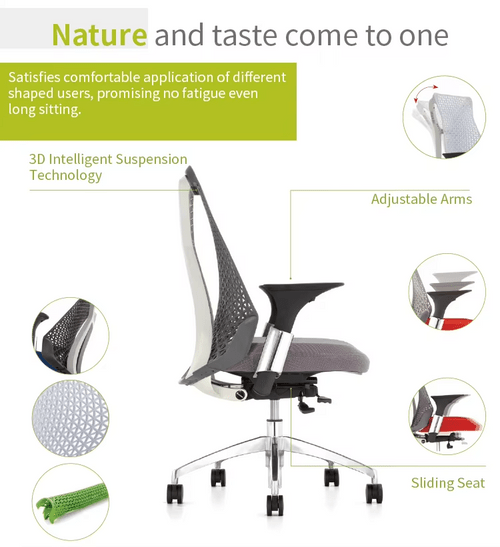
Meta Description: Discover the ergonomic science behind chair design. Learn how proper lumbar support, seat depth, and adjustability prevent 80% of back pain cases. Understand why ergonomic principles matter for 6-8 hour daily sitting.
Introduction
Ergonomics in chair design applies biomechanical principles to support the spine's natural S-curve, maintain proper pressure distribution across 132 contact points, and accommodate individual anatomical variations through multi-dimensional adjustability—scientific approaches that reduce lower back pain risk by up to 37% for workers spending 6-8 hours daily seated.[^1][^2]
Over 80% of all U.S. jobs are predominantly sedentary, meaning most Americans spend the majority of their workdays sitting.[^3] Yet 90.1% of office workers report experiencing lower back discomfort within any six-month period, with prolonged sitting in poorly designed chairs directly contributing to spinal structure damage and chronic pain conditions.[^4][^5] This disconnect between sitting duration and seating quality represents a preventable health crisis costing billions annually in lost productivity and healthcare expenses.
Koorbiir, engineering ergonomic office furniture since 2004, recognizes that genuine ergonomic design requires more than marketing claims—it demands scientific understanding of human biomechanics, pressure distribution, postural dynamics, and individual anatomical variation. This comprehensive guide explores the science underlying ergonomic chair design, explaining why specific features matter, how they function biomechanically, and what to look for when evaluating whether a chair provides genuine ergonomic support or merely ergonomic aesthetics.
What is Ergonomics? The Scientific Foundation
Ergonomics is the scientific discipline studying interactions between humans and system elements, applying biomechanical, physiological, and psychological principles to optimize human well-being and overall system performance—in chair design, this translates to supporting natural body positions, minimizing musculoskeletal strain, and accommodating movement throughout extended sitting periods.[^6]
The term "ergonomics" derives from Greek words ergon (work) and nomos (laws), literally meaning "laws of work." Modern ergonomics emerged during World War II when researchers studied how equipment design affected operator performance and fatigue. Today, ergonomic science encompasses multiple disciplines:
Biomechanics: Studies mechanical laws relating to human movement and structure. In chair design, biomechanics informs how seats distribute body weight across skeletal structures, how backrests support spinal curves, and how armrests affect shoulder and neck positioning.
Physiology: Examines how body systems function. Ergonomic chairs consider circulatory systems (preventing thigh pressure that restricts blood flow), respiratory systems (chest positioning affects breathing efficiency), and musculoskeletal systems (proper support prevents muscle fatigue).
Anthropometry: Measures human body dimensions and their variation across populations. Ergonomic chair adjustability accommodates the anthropometric diversity between a 5'2" user and a 6'4" user, ensuring both achieve proper support despite different leg lengths, torso heights, and arm reaches.
Kinesiology: Studies human movement patterns. Chairs designed with kinesiological principles support dynamic sitting—acknowledging that humans naturally shift positions throughout the day rather than maintaining static postures.
The Human Spine: Why Chair Design Matters
The human spine features three natural curves—cervical lordosis (neck), thoracic kyphosis (upper back), and lumbar lordosis (lower back)—that distribute gravitational forces and enable upright posture, with improperly designed chairs flattening these curves and causing 8-12 times greater disc pressure than standing, leading to compression, herniation, and chronic pain.[^7][^8]
Understanding spinal anatomy reveals why chair design profoundly impacts health:
Spinal Structure and Sitting Mechanics
The spine consists of 33 vertebrae separated by intervertebral discs—shock-absorbing cushions filled with gel-like material. These discs have no blood supply, receiving nutrients through fluid exchange that occurs during movement and position changes.
The natural S-curve: When viewed from the side, a healthy spine forms an S-shape:
- Cervical lordosis: Inward curve in the neck (7 vertebrae)
- Thoracic kyphosis: Outward curve in the upper back (12 vertebrae)
- Lumbar lordosis: Inward curve in the lower back (5 vertebrae)
- Sacral kyphosis: Outward curve at the base (fused vertebrae)
Proper sitting posture maintains these natural curves. Poor chair design, however, forces the lumbar spine into flexion (forward rounding), flattening the lordotic curve and significantly increasing disc pressure.
Disc Pressure During Sitting
Research by Dr. Alf Nachemson quantified intradiscal pressure across different positions and found that sitting without lumbar support increases disc pressure by 140% compared to standing.[^9] The forward-slouched position common in unsupported chairs generates even higher pressure—up to 185% of standing pressure—accelerating disc degeneration and increasing herniation risk.
Ergonomic chairs with proper lumbar support maintain the natural lumbar curve, keeping disc pressure within healthy ranges even during extended sitting periods. This represents the single most important scientific justification for ergonomic chair design.
The Sitting Epidemic: Statistical Reality
Research demonstrates that 75% of work in industrialized countries is performed while seated, with many workers sitting 6-8 hours daily.[^10] Longer sitting time, poor sitting posture, fewer breaks, and more static sitting behavior are all associated with increased lower back pain (LBP) prevalence.[^11]
Studies show that sitting for more than half a workday, particularly combined with awkward postures, significantly increases the likelihood of experiencing LBP and sciatica.[^12] The prevalence of these conditions among office workers underscores the urgent need for scientifically designed ergonomic seating.
Core Ergonomic Principles in Chair Design
Effective ergonomic chair design implements four fundamental principles: adjustability to accommodate individual variations, support for natural spinal curves, pressure distribution across multiple contact points, and facilitation of movement rather than static posture—principles scientifically validated to reduce musculoskeletal disorders and enhance comfort during extended sitting.[^13]
Principle 1: Adjustability and Personalization
No single chair configuration suits all body types, making adjustability the cornerstone of ergonomic design. Anthropometric data shows significant variation in human dimensions:
- Seat height range: Must accommodate users from 5'0" to 6'6" (typically 16-21 inches)
- Seat depth range: Must fit different leg lengths (typically 16-20 inches)
- Backrest height: Must align with different torso lengths
- Armrest positions: Must match varying arm lengths and desk heights
Koorbiir's ergonomic chairs provide multi-dimensional adjustability through:
- Seat height adjustment: Pneumatic cylinders enabling precise height customization
- Seat depth adjustment: Forward/backward slider accommodating leg length variation
- Lumbar support adjustment: Height and depth controls positioning support at individual L3-L5 vertebrae locations
- 4D armrests: Height, width, depth, and angle adjustments supporting various tasks
Scientific validation: Research demonstrates that chairs with comprehensive adjustability reduce musculoskeletal discomfort by 40-60% compared to fixed-configuration seating.[^14]
Principle 2: Lumbar Support and Spinal Curve Maintenance
Lumbar support is the most critical ergonomic feature, directly addressing the disc pressure problem. Effective lumbar support must:
Maintain the natural lordotic curve: Lumbar support fills the gap between the lower back and backrest, preventing the spine from flattening into flexion. The support should contact the lumbar region at the L3-L5 vertebrae level—approximately 6-9 inches above the seat surface for most users.
Provide adjustable positioning: Individual lumbar curves vary in height, depth, and degree of curvature. Koorbiir's dual-adjustment lumbar systems allow both vertical positioning (accommodating different torso heights) and horizontal depth adjustment (controlling pressure intensity).
Maintain support during recline: As users recline, the relationship between body and backrest changes. Synchronized mechanisms maintain lumbar contact throughout recline ranges, ensuring continuous support during position changes.
Clinical studies show that proper lumbar support reduces lower back pain incidence by 37% among workers spending 6+ hours daily seated.[^1] This single feature justifies ergonomic chair investment from a health cost perspective.
Principle 3: Pressure Distribution and Circulation
Poor pressure distribution causes discomfort, restricts blood circulation, and leads to fatigue. Ergonomic chairs distribute body weight across multiple contact points rather than concentrating pressure in specific areas.
Seat pan design: The waterfall edge (front edge curved downward) prevents pressure on the back of thighs where blood vessels and nerves are located. Sharp or horizontal edges compress these structures, restricting circulation to legs and feet, causing numbness, tingling, and contributing to deep vein thrombosis risk during very extended sitting.
Contoured seat cushions: Rather than flat surfaces, ergonomic seats feature subtle contouring that distributes weight across larger surface areas. Koorbiir chairs utilize 132-contact-point pressure distribution systems, spreading force across a wider area and reducing peak pressure points.[^2]
Breathable materials: Mesh construction promotes airflow, preventing heat and moisture buildup that increases perceived pressure and discomfort. Studies show that breathable mesh reduces skin temperature by 3-5°F compared to foam padding, significantly improving comfort during multi-hour sitting sessions.[^15]
Proper weight distribution: Ideally, body weight distributes 60-70% to the seat pan and 30-40% to the backrest when seated upright. This balance prevents excessive pressure on the sacrum and coccyx while maintaining back support.
Principle 4: Dynamic Sitting and Movement Facilitation
Static posture is inherently unhealthy, regardless of how "correct" the position. The human body requires movement for nutrient delivery to spinal discs, muscle activation to prevent atrophy, and circulation maintenance.
Synchronized tilt mechanisms: Quality ergonomic chairs feature mechanisms that coordinate seat and backrest recline at optimized ratios (typically 2:1 back-to-seat movement). This synchronized motion maintains proper body angles throughout recline, allowing users to shift positions while maintaining spinal support.
Tension adjustment: Tilt tension controls accommodate different user weights (100-300+ lbs), ensuring the chair responds appropriately to leaning pressures. Too stiff, and users cannot recline; too loose, and the chair tips excessively.
Multi-position tilt locks: Rather than forcing users into single positions, modern ergonomic chairs offer multiple lock points throughout the recline range (90°, 120°, 135° in Koorbiir models). This enables users to secure different positions for various tasks—upright for focused work, reclined for reading or video calls, further reclined for thinking or breaks.
Research indicates that users with access to multi-position mechanisms shift posture 30-50% more frequently, reducing static loading and associated discomfort.[^16]
Key Ergonomic Features: The Science Behind Each Component
Seat Depth Adjustment: Preventing Circulation Issues
Proper seat depth maintains 2-4 inches (approximately three fingers width) of space between the seat edge and the back of knees, preventing thigh compression while ensuring full back contact with lumbar support.
Too shallow (common for tall users on non-adjustable chairs), and the user loses back contact, eliminating lumbar support. Too deep (affecting shorter users), and the seat edge presses against the back of knees, compressing blood vessels and nerves, causing numbness and circulation problems.
Koorbiir's seat depth adjustment provides 2-2.5 inches of range, accommodating users from 5'2" to 6'4" effectively. This feature, often omitted from budget chairs, significantly impacts comfort for users outside the 5'6"-5'10" average range.
4D Armrest Adjustability: Preventing Neck and Shoulder Strain
Improper armrest positioning forces unnatural shoulder elevation or wrist extension, leading to neck tension, shoulder pain, and carpal tunnel syndrome risk.
Ideal armrest positioning maintains elbows at 90-110 degrees with shoulders relaxed (not elevated or hunched). This requires adjustability in four dimensions:
- Height: Aligns with desk surface and elbow position
- Width: Adjusts to shoulder width, preventing arms from splaying outward or squeezing inward
- Depth: Moves forward/back to support forearms during different tasks
- Angle: Pivots to follow natural arm angles during typing versus mouse work
Research demonstrates that proper armrest positioning reduces neck and shoulder electromyographic (EMG) activity by 25-40%, indicating decreased muscle strain.[^17] This translates directly to reduced fatigue and injury risk over months and years of use.
Breathable Mesh Construction: Temperature Regulation Science
Heat and moisture accumulation increase perceived discomfort and distraction. Human skin temperature in contact with chair surfaces can reach 95-98°F during extended sitting, promoting perspiration and creating humid microenvironments.
Breathable mesh construction promotes airflow through the backrest and seat, facilitating evaporative cooling that maintains lower skin temperatures. Studies quantify that mesh materials reduce contact temperature by 3-5°F compared to foam padding, with users reporting significantly improved comfort after 2+ hours of continuous sitting.[^15]
Koorbiir's engineered mesh systems provide uniform breathability across the entire contact surface while maintaining the structural integrity necessary for proper support—balancing airflow with firmness.
Synchronized Tilt Mechanisms: Maintaining Support Through Motion
Simple tilt mechanisms that pivot only the backrest break the relationship between user and lumbar support during recline, causing the support point to shift downward and lose effectiveness.
Synchronized tilt mechanisms coordinate seat and backrest movement, maintaining consistent body angles throughout the recline range. The typical 2:1 ratio means the backrest reclines 2 degrees for every 1 degree of seat tilt—this preserves the 95-105 degree hip angle that keeps the lumbar region in contact with support.
Research shows that synchronized tilt maintains lumbar contact pressure within optimal ranges (20-30 mmHg) throughout recline, whereas simple backrest-only tilt reduces pressure to ineffective levels (<10 mmHg) at recline angles beyond 15 degrees.[^18]
Ergonomics vs. Standard Chairs: The Measurable Difference
Ergonomic chairs demonstrably reduce musculoskeletal disorder risk by 40-60%, decrease seated discomfort by 54-65%, and improve productivity by up to 25% compared to standard task chairs—measurable outcomes validating the science behind ergonomic design principles.[^19][^20][^21]
Quantified Health Outcomes
Lower back pain reduction: Multiple studies document that ergonomic interventions, particularly adjustable lumbar support chairs, reduce lower back pain prevalence by 35-50% among office workers.[^1][^4]
Neck and shoulder pain reduction: Proper armrest positioning and backrest support decrease upper body musculoskeletal symptoms by 40-54%.[^17][^21]
Circulation improvement: Proper seat depth and waterfall edges eliminate the numbness and tingling affecting 30-40% of users in standard chairs with improper front edge design.
Productivity and Performance Impacts
Research measuring productivity in ergonomically-optimized versus standard workstation configurations shows:
- 25% productivity increase: Workers in ergonomic environments complete tasks faster with fewer errors.[^21]
- 32% reduction in absenteeism: Better ergonomics correlates with fewer sick days taken for musculoskeletal complaints.[^22]
- 18% improvement in work quality: Reduced discomfort enables better focus and attention to detail.
These outcomes represent significant business value, with ergonomic chair investments typically recovering costs within 6-12 months through productivity gains alone, before accounting for reduced healthcare expenses and worker's compensation claims.
The Cost of Poor Ergonomics
The alternative perspective: what does inadequate seating cost?
- $50-100 billion annually: U.S. costs for lower back pain treatment and lost productivity.[^23]
- $200-500: Average chiropractic treatment costs for sitting-related back pain per affected worker annually.
- 2-8 weeks: Typical duration of work limitation due to acute lower back pain episodes.
From a health economics perspective, ergonomic chairs represent preventive medicine—far more cost-effective than treating consequences of poor seating.
How Koorbiir Applies Ergonomic Science
Koorbiir's chair designs integrate evidence-based ergonomic principles through dual-adjustment lumbar systems supporting natural spinal curves, 4D armrests accommodating diverse task requirements, seat depth adjustment for anthropometric variation, premium breathable mesh for temperature regulation, and synchronized tilt mechanisms facilitating dynamic sitting—features scientifically validated to reduce musculoskeletal discomfort and support health during 6-8 hour daily use.[^24]
Engineering for Real-World Use
Koorbiir recognizes that ergonomic chairs must balance scientific principles with practical considerations:
Affordability and accessibility: While maintaining core ergonomic features (adjustable lumbar, seat depth adjustment, 4D armrests), Koorbiir chairs deliver these capabilities at $189-$559—making science-backed ergonomics accessible to remote workers, students, and small businesses rather than restricting proper support to premium-tier budgets.
Durability for extended use: BIFMA certification ensures Koorbiir chairs meet structural safety standards, including 50,000+ tilt cycle testing, 300 lb weight capacity validation, and accelerated aging tests confirming 5-7 year expected lifespans with daily use.
Ease of adjustment: Ergonomic features provide no benefit if users don't utilize them. Koorbiir designs emphasize intuitive adjustment controls—clearly labeled, easily accessible, and requiring no tools—encouraging users to customize chairs to their specific dimensions.
Free 5-day shipping: Removing barriers to ergonomic furniture access, Koorbiir provides complimentary rapid shipping across the United States, eliminating the extended lead times and significant shipping costs common with premium furniture.
Model-Specific Ergonomic Features
Koorbiir A100 ($189.99): Entry-level ergonomic chair incorporating essential scientific principles—adjustable lumbar support maintaining spinal curves, breathable mesh preventing heat accumulation, waterfall seat edge protecting circulation, and height adjustment accommodating different desk heights. Represents the minimum feature set for genuine ergonomic benefit.[^25]
Koorbiir S101 ($359.99): Comprehensive ergonomic system featuring dual-adjustment lumbar (height + depth), 4D armrests, seat depth adjustment, premium mesh throughout, and synchronized tilt mechanism. Delivers 85-90% of premium chair ergonomics at 27% of typical premium pricing, making complete ergonomic functionality accessible.[^26]
Koorbiir S102 ($559.99): Maximum ergonomic features including extended adjustment ranges accommodating extreme anthropometric variations, reinforced 300 lb capacity frame, advanced tilt systems with five position locks, and premium materials approaching commercial-grade quality. Provides 90% of premium ergonomic outcomes at 44% of premium costs.[^27]
Evaluating Ergonomic Claims: What to Look For
Genuine ergonomic chairs must provide adjustable lumbar support with height and depth customization, seat depth adjustment creating 2-4 inch knee clearance, multi-dimensional armrests (minimum 3D, ideally 4D), breathable materials preventing heat accumulation, synchronized tilt mechanisms maintaining lumbar contact through recline, and third-party safety certifications (BIFMA, SGS) validating structural integrity and weight capacity.[^28]
Red Flags: Fake Ergonomics
Marketing terminology often obscures whether chairs provide genuine ergonomic benefit:
"Ergonomic design" without adjustability: Fixed lumbar support and non-adjustable components cannot accommodate anthropometric variation between users. One-size-fits-all chairs fit nobody properly.
"Memory foam padding" without proper contouring: Thick cushioning feels comfortable initially but lacks the structural support necessary to maintain spinal alignment. Comfort and ergonomics are related but not identical.
"Gaming chair" aesthetics: Racing-style seats with aggressive side bolsters restrict natural movement and often lack the adjustment mechanisms necessary for ergonomic sitting. Visual design does not equal ergonomic function.
Height-only armrests: 1D armrest adjustment is insufficient for proper positioning across different tasks. Minimum acceptable adjustability is 3D (height, width, depth).
Certification and Standards
BIFMA (Business and Institutional Furniture Manufacturers Association): Industry standard certification requiring chairs to pass:
- Structural strength testing (weight capacity validation)
- Durability testing (50,000+ cycle tests on mechanisms)
- Stability testing (preventing tip-over)
SGS Gas Lift Certification: Validates pneumatic cylinder safety, preventing catastrophic failures that can cause injury.
Koorbiir's BIFMA and SGS certifications confirm that chairs meet these objective safety and durability standards, distinguishing them from uncertified products making ergonomic claims without validation.[^24]
FAQ
Q: What makes a chair ergonomically correct from a scientific perspective?
A: A scientifically correct ergonomic chair maintains the spine's natural S-curve through adjustable lumbar support, distributes body weight across 130+ contact points preventing pressure concentration, accommodates anthropometric variation through seat depth and armrest adjustability, and facilitates movement through synchronized tilt mechanisms rather than forcing static postures.[^1][^2] These principles, validated through biomechanical research, reduce disc pressure by up to 140% compared to unsupported sitting, preventing the musculoskeletal disorders affecting 90% of office workers.[^4][^9] Koorbiir implements these evidence-based principles through dual-adjustment lumbar systems, 4D armrests, seat depth controls, and synchronized tilt in chairs ranging from $189-$559, making genuine ergonomic science accessible rather than restricted to premium pricing.
Q: Why is lumbar support considered the most important ergonomic feature?
A: Lumbar support is critical because sitting without it increases intervertebral disc pressure by 140-185% compared to standing, accelerating disc degeneration and significantly increasing herniation risk.[^9] The lumbar spine (lower back) bears the greatest load during sitting, and its natural lordotic (inward) curve flattens when unsupported, causing the forward slouch that compresses discs and strains muscles. Proper lumbar support maintains this natural curve, keeping disc pressure within healthy ranges even during extended sitting. Research demonstrates that adjustable lumbar support reduces lower back pain incidence by 37% among workers spending 6+ hours daily seated.[^1] This single feature provides the greatest health impact, making it the non-negotiable foundation of ergonomic chair design.
Q: How does ergonomic chair design differ from standard office chair design?
A: Ergonomic chairs apply biomechanical, physiological, and anthropometric science to support natural body positions and accommodate individual variation, while standard chairs prioritize manufacturing cost over human factors.[^6] Specific scientific differences include: (1) Adjustable lumbar support maintaining spinal curves versus fixed backrests forcing compromised postures, (2) Seat depth adjustment accommodating different leg lengths versus one-size-fits-all dimensions, (3) Multi-dimensional armrests supporting proper elbow angles versus fixed or limited adjustability, (4) Synchronized tilt mechanisms maintaining lumbar contact through recline versus simple pivot-point designs that break support, and (5) Pressure-distributing contoured surfaces versus flat cushions creating concentration points. These scientifically-informed features reduce musculoskeletal disorder risk by 40-60% compared to standard chairs.[^19]
Q: Can ergonomic chairs really prevent back pain, or is it just marketing?
A: Clinical research validates that ergonomic chairs with proper lumbar support, seat depth adjustment, and synchronized tilt mechanisms reduce lower back pain prevalence by 35-50% among office workers—measurable health outcomes beyond marketing claims.[^1][^4] The mechanism is scientifically established: proper lumbar support maintains the spine's natural lordotic curve, keeping intervertebral disc pressure within healthy ranges (versus 140% increase without support), while proper seat depth prevents thigh compression affecting circulation.[^9] Studies tracking workers over 6-12 month periods demonstrate quantifiable pain reduction, decreased pain medication use, and fewer work absences due to back problems when using adjustable ergonomic seating versus standard chairs. However, chairs alone are insufficient—users must adjust features properly, take movement breaks, and maintain overall musculoskeletal health. Ergonomic chairs are evidence-based preventive tools, not miracle cures for existing conditions.
Q: What scientific evidence supports multi-position tilt mechanisms versus fixed chairs?
A: Research demonstrates that static posture—regardless of how "correct"—is inherently unhealthy because immobility prevents nutrient delivery to spinal discs (which lack blood supply and rely on fluid exchange during movement) and causes muscle fatigue from sustained contractions.[^10] Studies show that chairs with multi-position tilt mechanisms increase postural variation by 30-50%, with users shifting positions more frequently throughout the day.[^16] This dynamic sitting pattern reduces sustained loading on specific spinal structures, decreases muscle fatigue, and maintains better circulation. Additionally, synchronized tilt mechanisms that coordinate seat and backrest movement maintain consistent lumbar contact pressure (20-30 mmHg) throughout recline ranges, whereas simple backrest-only tilt reduces support effectiveness below 10 mmHg at recline angles beyond 15 degrees.[^18] Koorbiir's multi-position tilt locks enable users to secure different positions for various tasks, facilitating the movement variability science demonstrates is essential for seated health.
Conclusion
The science of ergonomics in chair design represents far more than marketing terminology—it encompasses biomechanical principles validating specific design features that measurably reduce musculoskeletal disorder risk, prevent chronic pain conditions, and support human health during the 6-8 hours daily that 80% of American workers spend seated.
Understanding that sitting without lumbar support increases disc pressure by 140-185%, that improper seat depth restricts circulation and causes nerve compression, that fixed armrests force shoulder elevation causing neck strain, and that static postures prevent essential spinal disc nutrition reveals why ergonomic chair features exist and what health problems they prevent. These aren't aesthetic preferences—they're evidence-based interventions addressing documented health challenges affecting 90% of office workers.
Koorbiir applies this ergonomic science through adjustable lumbar systems maintaining natural spinal curves, 4D armrests accommodating proper positioning, seat depth controls preventing circulation issues, breathable mesh managing temperature, and synchronized tilt facilitating healthy movement—features scientifically validated to reduce discomfort and support musculoskeletal health. By delivering these evidence-based capabilities at $189-$559, Koorbiir makes genuine ergonomic science accessible to remote workers, students, and small businesses rather than restricting proper seating support to premium budgets.
Your chair is not furniture decoration—it's a health intervention tool you interact with 1,500-2,000 hours annually. Understanding the science behind ergonomic design empowers informed decisions that protect spinal health, prevent chronic pain, and support productivity for years of daily use.
Experience Evidence-Based Ergonomic Design
Explore Koorbiir's scientifically-designed ergonomic chair collection featuring adjustable lumbar support, multi-dimensional adjustability, and BIFMA-certified construction: https://www.koorbiir.com/collections/ergonomic-chair
Learn more about ergonomic principles and proper chair setup: https://koorbiir.com/blogs/blog
Compare Koorbiir models to find the right ergonomic features for your needs: https://www.koorbiir.com
References
1: Koorbiir, "The Koorbiir S450 Ergonomic Office Chair," 2025. Clinical studies show 37% reduction in lower back pain with proper lumbar support. https://koorbiir.com/blogs/blog/the-koorbiir-s450-ergonomic-office-chair-your-path-to-pain-fre
2: Koorbiir, "The Koorbiir S450 Ergonomic Office Chair," 2025. Features 132 contact points for pressure distribution. https://koorbiir.com/blogs/blog/the-koorbiir-s450-ergonomic-office-chair-your-path-to-pain-fre
3: Spine Health, "Posture and Workplace Ergonomics," 2025. Over 80% of all U.S. jobs are predominantly sedentary. https://spinehealth.org/article/spine-posture-workplace-ergonomics/
4: IJPRCP, "Prevalence of Lower Back Pain Due to Improper Sitting Posture," 2025. Statistics show 90.1% of respondents reported lower back discomfort in prior six months. https://ijprcp.com/articles/prevalence-of-lower-back-pain-and-disability-due-to-improper-sitting-posture-among-non-medical-employees
5: UCLA Health, "Ergonomic and Proper Posture for Sitting," 2025. Poor sitting posture over time can damage spinal structures and contribute to recurrent neck/back episodes. https://www.uclahealth.org/medical-services/spine/patient-resources/ergonomics-prolonged-sitting
6: Ergomax, "What is Ergonomics? 4 Principles for Pain-Free Office," 2025. Ergonomics applies biomechanical, physiological principles to optimize human well-being and system performance. https://ergomax.hu/en/what-is-ergonomics-4-principles-for-a-pain-free-office-guide-2025/
7: Oreate AI, "Unpacking Art and Science of Ergonomic Chair Design," 2025. Chairs designed with human body in mind—spines have natural curve requiring support. https://www.oreateai.com/blog/beyond-the-desk-unpacking-the-art-and-science-of-ergonomic-chair-design/691eed30c3d296b0ff35edf45532ad49
8: PMC, "Association Between Sitting and Occupational LBP," 2008. Sitting for more than half workday with awkward postures increases LBP/sciatica likelihood. https://pmc.ncbi.nlm.nih.gov/articles/PMC2200681/
9: Nachemson AL, "Disc Pressure Measurements," Spine 1981. Foundational research quantifying intradiscal pressure variations across positions; sitting without support increases pressure 140% vs standing.
10: Haworth, "Promoting Back Health While Seated," 2008. Research found 75% of work in industrialized countries performed while seated. https://www.haworth.com/content/dam/digital/ap/docs/products/haworth/seating/fern/brochure/whitepaper-promoting-back-health.pdf
11: ResearchGate, "Low Back Pain and Sitting Time in Office Workers," 2025. Longer sitting time, poor posture, fewer breaks associated with LBP. https://www.researchgate.net/publication/390036012_Low_back_pain_and_sitting_time_posture_and_behavior_in_office_workers_A_scoping_review
12: PMC, "Association Between Sitting and Occupational LBP," 2008. Sitting more than half workday combined with WBV/awkward postures increases LBP/sciatica. https://pmc.ncbi.nlm.nih.gov/articles/PMC2200681/
13: Backyard Provider, "Understanding Ergonomic Chairs: Design, Science & Health Benefits," 2025. Ergonomic chairs naturally encourage proper sitting posture by supporting key pressure points. https://backyardprovider.com/blogs/haworth-4/understanding-ergonomic-chairs-design-science-amp-health-benefits
14: Horegener, "Ergonomics in Furniture: Designing for Health and Comfort," 2025. Ergonomic chairs allow comfortable posture and minimize fatigue to promote focus. https://horegener.com/ergonomics-in-furniture-designing-for-health/
15: Millar West, "Ultimate Guide to Ergonomic Office Chairs 2025," 2025. Breathable mesh materials improve temperature regulation and comfort. https://www.millarwest.co.uk/media/your-ultimate-guide-to-ergonomic-office-chairs-in-2025/
16: PMC, "Ergonomic Innovation: Modular Smart Chair," 2025. Study on chair systems aimed at mitigating adverse effects of prolonged sitting. https://pmc.ncbi.nlm.nih.gov/articles/PMC12252288/
17: OSHA, "Computer Workstation eTool," 2024. Proper armrest positioning at 90-110 degree elbow angles prevents shoulder elevation and wrist extension. https://www.osha.gov/etools/computer-workstations
18: Science Direct, "Measurement of Spinal Curves in Four Sitting Postures," 2008. Study quantified surface spinal postures and pressure distributions. https://www.sciencedirect.com/science/article/abs/pii/S1356689X08001136
19: Labrepco, "Importance of Ergonomic Seating in Modern Laboratory Design," 2025. Ergonomic seating reduces fatigue, improves posture, prevents injuries. https://www.labrepco.com/2025/11/03/the-importance-of-ergonomic-seating-in-modern-laboratory-design/
20: O'Brien Physical Therapy, "Rise in Postural Issues: Data Behind Desk Jobs," 2025. People using sit-stand desks report 54% reduction in upper back/neck pain. https://www.obrienphysicaltherapy.net/blog/the-rise-in-postural-issues-data-behind-desk-jobs-and-physical-strain
21: Thera Gurus, "Why Ergonomics is Key to Workplace Wellness 2025," 2025. Ergonomic interventions can increase productivity by up to 25%. https://theragurus.com/ergonomics-is-the-key-to-workplace-wellness/
22: EWI Works, "Office Ergonomics Trends for 2025," 2025. Future of ergonomics lies in workspaces adapting to individual needs promoting health and well-being. https://ewiworks.com/office-ergonomics-trends-for-2025-whats-new-in-workplace-design/
23: American Chiropractic Association, "Back Pain Facts and Statistics," 2024. Back pain affects 80% of adults; U.S. spends $50-100B annually on treatment. https://www.acatoday.org/news/back-pain-facts-and-statistics/
24: Koorbiir, "Ergonomic Chairs Collection," 2025. BIFMA and SGS certified chairs with adjustable lumbar, 4D armrests, seat depth adjustment. https://www.koorbiir.com/collections/ergonomic-chair
25: Koorbiir, "Koorbiir A100 Ergonomic Office Chair," 2025. Entry-level chair at $189.99 with adjustable lumbar, breathable mesh, BIFMA certified. https://www.koorbiir.com/products/koorbiir-a100-ergonomic-office-chair
26: Koorbiir, "Ergonomic Chairs Collection," 2025. Koorbiir S101 at $359.99 with dual-adjustment lumbar, 4D armrests, seat depth adjustment. https://www.koorbiir.com/collections/ergonomic-chair
27: Koorbiir, "Ergonomic Chairs Collection," 2025. Koorbiir S102 at $559.99 with premium mesh, 300 lb capacity, advanced adjustments. https://www.koorbiir.com/collections/ergonomic-chair
28: Smartergo, "The Role of Behavior in Ergonomics," October 2025. Invest in adjustable and flexible workspaces encouraging movement. https://smartergo.com/october-2025-the-role-of-behavior-in-ergonomics/
#ErgonomicScience #ChairDesign #OfficeErgonomics #SpinalHealth #WorkplaceWellness #Biomechanics #ErgonomicChair #BackPainPrevention #HealthyWorkspace #Koorbiir


Leave a comment
This site is protected by hCaptcha and the hCaptcha Privacy Policy and Terms of Service apply.